Doubling-Time-Best-Of.mp3
Doubling-Time-Best-Of.mp4
Doubling-Time.mp3
Doubling-Time.mp4
Doubling-Time-intro.mp3
[Verse 1]
Acceleration
(Becomes a thing of the past)
At last at last
(The past piles up so fast)
[Bridge]
Our you sure
(Of a future?)
[Chorus]
The trouble with doubling time
Is it’s half of half-the-time
(All the time)
Like per second per second… I reckon…
It just keeps going and growing
(Shorter and shorter)
[Bridge]
Faster and faster
(Into disaster)
[Verse 2]
100 years goes to 10
(Then… to two)
Not a matter of when
(It’s happening to you)
[Bridge]
Our you sure
(Of a future?)
[Chorus]
The trouble with doubling time
Is it’s half of half-the-time
(All the time)
Like per second per second… I reckon…
It just keeps going and growing
(Shorter and shorter)
[Bridge]
Drastic (disorder)
Faster and faster
(Into disaster)
[Chorus]
The trouble with doubling time
Is it’s half of half-the-time
(All the time)
Like per second per second… I reckon…
It just keeps going and growing
(Shorter and shorter)
[Outro]
Drastic (disorder)
Faster and faster
(Into disaster)
[Instrumental, Whistle Solo]
A SCIENCE NOTE
Beyond Linear Change: The Reality of Exponential Acceleration
When we began our climate experiments in the 1990s, we assumed significant change would occur over millennia. If climate change progressed linearly, this would hold. However, by the late 1990s, our findings–and global observations–began to show that climate impacts were accelerating exponentially.
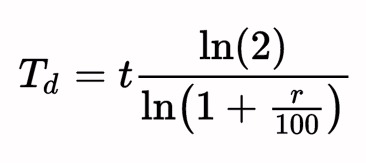
Doubling time — the period required for a quantity to double — is a critical marker of exponential growth. For anthropogenic climate impacts, this period has collapsed at an alarming rate. By 2020, the doubling time for key impacts such as sea level rise had shrunk from 100 years to just 10 years, with rates increasing from about 1.5 mm/year to over 3 mm/year. If left unchecked, this trajectory could result in sea-level increases of up to one foot per year by 2050.
Extreme Events: The New Normal
Extreme weather events are intensifying and occurring with alarming frequency as warming oceans, disrupted jet streams, and accelerating atmospheric rivers destabilize the climate system. What were once “500-year” events now occur every 5-10 years, and in many places, annually.
- Heatwaves are now 5x more likely, projected to become 10x more likely within 5 years and 20x within a decade, consistent with the shrinking climate doubling period.
- Storms and flooding are not only more frequent but also exponentially more destructive due to physics: wind and water forces scale with the square of velocity (v²) and, in the case of water, with 800x the density of air, making even modest increases in flow speed dramatically more damaging.
- Wildfires, fueled by heat, lightning, and brown carbon feedback loops, are igniting with greater speed and ferocity, as seen during Canada’s record-breaking 2023 wildfire season.
Non-linear acceleration is now confirmed: The 2-7°F rise in temperatures during recent European heatwaves translated to a tripling of heat deaths, demonstrating the amplified sensitivity of human and natural systems to seemingly small increases in mean temperatures. For every 1°C (1.8°F) increase, the atmosphere can hold 7% more water vapor, intensifying storms and the humidity of heatwaves, compounding mortality risk.
2025 Update: Doubling Period Shrinks Further
Originally estimated at 100 years, the climate doubling period–how quickly climate impacts double in intensity–contracted to 10 years. By 2024, new observations confirmed the doubling period had shortened further to just 2 years. 100 years → 10 years → 2 years. This means the damage caused by climate change today is already double what it was just two years ago. If this trend continues, it could be four times worse in two years, eight times worse in four years, and up to 64 times worse within a decade. Critically, these estimates are conservative, assuming the doubling period does not continue to shrink even further as tipping points and feedback loops accelerate the crisis.
The surge in persistent heat domes and resonance patterns in the jet stream confirms that critical thresholds in the climate system are being crossed faster than models predicted. As warming oceans and a destabilized jet stream lock in planetary wave patterns, heat domes and extreme weather events persist longer, amplifying both frequency and intensity.
In 2023, Earth’s surface temperatures averaged over 3°C above pre-industrial levels–double the Paris Agreement’s 1.5°C ceiling. Scientists agree that a 2°C rise will trigger tipping points and feedback loops, releasing carbon from permafrost, weakening the AMOC, and destabilizing polar ice sheets. This cascading “Domino Effect” could push global temperatures toward 6°C, rendering large regions of the planet uninhabitable within this century.
As climate change accelerates, what was once a 1,000-year flood now occurs as a 100-year or even 10-year event. Violent rain, flash flooding, and catastrophic water events are rewriting our understanding of “normal,” with Chapel Hill’s recent “1,000-year” flood serving as a stark warning that the climate system is entering a phase of nonlinear, runaway change that threatens human systems, infrastructure, and global stability.
Ignite a Domino Effect: Albedo, Brown Carbon, AMOC, Permafrost, Amazon Rainforest Dieback, Sea Level Rise Pulses, Hydroclimate Whiplash, and Arctic Sea Ice Brouse and Mukherjee (2025)
- Expanded Explanation of the Key Climate Feedback Loops Fueling the Amazon Collapse Brouse and Mukherjee (2025)
- A Simplified Breakdown of the Key Climate Feedback Loops Brouse (2025)
Tipping Cascades: The Nonlinear Dominoes of Climate Collapse Brouse and Mukherjee (2025)
The Domino Collapse: Amazon Rainforest Dieback and the Ozone Feedback Loop Brouse and Mukherjee (2025)
Climate Change, Doubling Time, and the Eroding Value of Jersey Shore Real Estate Brouse (2025)