Outburst-Best-Of.mp3
Outburst-Best-Of.mp4
Outburst.mp3
Outburst.mp4
Outburst-intro.mp3
[Verse 1]
All pent up… gonna let it out
(There’s no doubt)
It’s not a matter of if,
It’s a matter of when.
(Then….)
[Bridge]
Outburst
{Chorus]
Pouring up and out
(In urgency)
Shout!
(A Glacial Flood Emergency)
New urgency (see?)
[Bridge]
(Don’t know… how the flow… is gonna go)
[Verse 2]
Did you try sticking
… your finger… (in the dike)
… praying… wishing…
(Despite the trite)
[Bridge]
Outburst
(Hate to bust your bubble)
Outburst
(Left it all as rubble)
{Chorus]
Pouring up and out
(In urgency)
Shout!
(A Glacial Flood Emergency)
New urgency (see?)
[Bridge]
(Don’t know… how the flow… is gonna go)
Outburst
(Hate to bust your bubble)
Outburst
(Left us all in rubble)
[Outro]
Outburst
(Case: the worst)
Under the flow
(Of getting to know)
A SCIENCE NOTE: Sudden Sea Level Pulses, Glacial Floods, and “Cork Release” Events
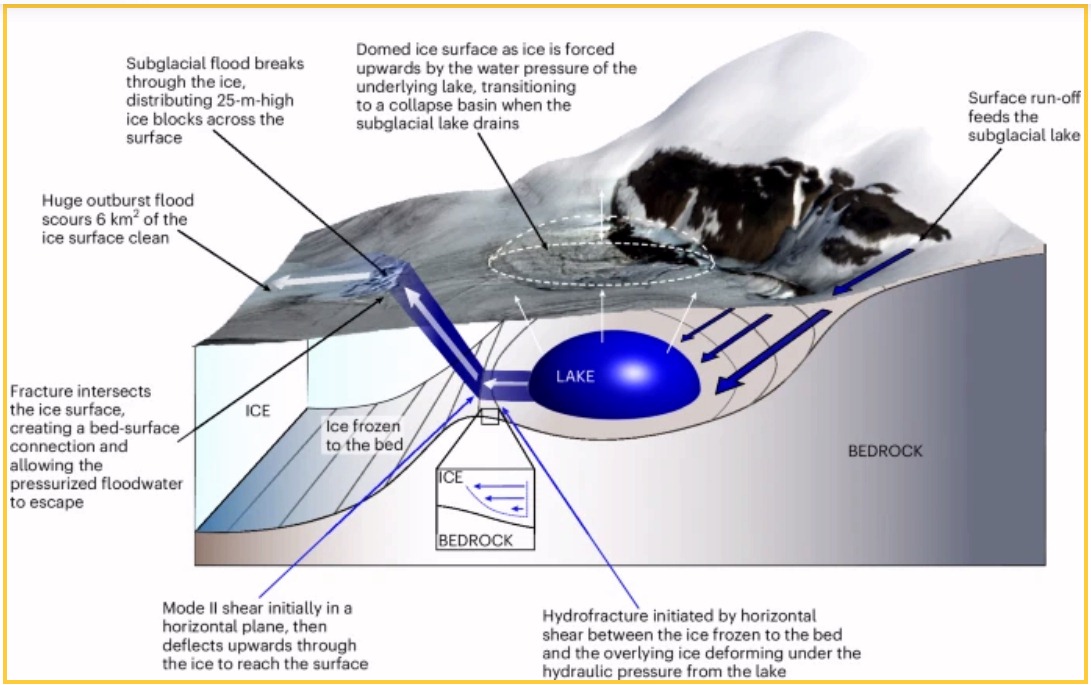
If you’ve been following the giant feedback loop example involving Sudden Sea Level Pulses and Cork Release events, there’s a paper documenting one in action — an outburst of 23 billion gallons of water in just ten days. That’s the equivalent of nine Niagara Falls roaring beneath the ice, warping and fracturing the once-pristine sheet into a chaotic mess.
The Earth’s climate system is a tightly woven network of interdependent processes. Disturb one, and you risk setting off a cascade of reinforcing feedback loops. Consider just one example: the potential collapse of the Atlantic Meridional Overturning Circulation (AMOC).
When the AMOC slows, tropical waters grow hotter while the Arctic warms even faster. This accelerates polar ice melt, raising global sea levels more quickly and injecting vast amounts of freshwater into the North Atlantic. The added freshwater disrupts ocean salinity and density, further weakening the AMOC in a dangerous feedback cycle.
Meanwhile, elsewhere in the system, Amazon droughts intensify under the altered climate, pushing the rainforest toward dieback and eventual desertification. This reduces the Amazon’s ability to recycle rainfall and sequester carbon, further amplifying global warming–and thus accelerating ice melt, sea level rise, and AMOC destabilization.
The Albedo Effect and Ice Melt
One of the most powerful feedbacks in the polar regions is the albedo effect. As bright, reflective ice melts, it reveals darker land or ocean surfaces that absorb far more solar energy. This speeds up further melting. While melting sea ice mainly changes heat balance without directly raising sea levels, the melting of land-based ice–especially from Greenland and Antarctica–not only raises global seas but also changes ocean salinity and temperature, further destabilizing circulation systems like the AMOC.
These ice sheets hold vast “corks” of land ice restraining enormous reservoirs of meltwater. When these corks break, sudden sea level rise pulses–sometimes 1-3 feet per year for multiple consecutive years–could occur. The impacts on coastlines, global weather, and ocean currents would be both severe and unpredictable.
The Greenland Ice Sheet Outburst Flood
Recent research has identified a startling example of this process. In the paper Outburst of a subglacial flood from the surface of the Greenland Ice Sheet (2025), scientists documented a 90-million-cubic-meter flood that forced its way upward through the ice sheet, bursting out at the surface. This was caused by the rapid drainage of a subglacial lake in a region where the bed was thought to be frozen solid–an event that current ice sheet models do not account for.
The flood’s upward path fractured the ice sheet, disrupting the downstream marine-terminating glacier and altering its flow. This bi-directional coupling between surface and basal hydrology highlights just how complex–and poorly understood–ice sheet dynamics truly are.
Over the last three decades, Greenland has lost roughly 169 billion tons of ice per year on average, contributing about 14 mm to global sea level rise. Roughly half of this loss comes from surface melting and runoff, which are projected to increase sharply as Arctic warming intensifies.
Alaska’s Mendenhall Glacier Outburst: A Glacial Flood Emergency
A massive upstream basin of rainwater and snowmelt, dammed by Alaska’s Mendenhall Glacier, began releasing in August of 2025, prompting officials to urge residents in parts of Juneau to evacuate ahead of a potentially dangerous surge of floodwater.
A glacial outburst flood occurs when meltwater or rainwater accumulates behind a natural ice dam, creating a substantial reservoir of water under pressure. In the case of the Mendenhall Glacier, snowmelt and rainfall from the upstream basin — ironically named Suicide Basin — accumulate behind the glacier, which acts as a solid barrier, trapping the water in depressions known as proglacial lakes or subglacial reservoirs. As the water volume increases, hydrostatic pressure builds against the ice dam. Ice behaves like a viscoelastic material–it can deform slowly under pressure but can fracture if stress exceeds its strength. The weight of the water eventually exceeds the ice’s ability to hold it, particularly if crevasses or melt channels weaken the glacier structure. Once the pressure exceeds the strength of the ice or underlying bedrock, cracks propagate rapidly, and water can exploit subglacial channels, forcing its way beneath or through the ice, a process known as hydraulic fracturing. When the dam fails, the water stored in the basin rushes downstream in a high-energy flood, converting potential energy into kinetic energy, generating destructive flow speeds and forces that can erode soil, uproot trees, damage infrastructure, and rapidly raise river levels. Warming temperatures increase surface melt and rainfall, filling these basins faster, while ice thinning and increased meltwater lubricate the glacier bed, reducing friction and making outbursts more likely. In essence, a glacial outburst results from the buildup of pressure from trapped water, ice weakening or cracking, and the sudden release of gravitational energy, producing a high-speed, destructive flood downstream.
Why This Matters
If hydrofracture events like this outburst become more frequent, the world could face abrupt, multi-foot-per-year sea level jumps–not the gradual rise most models currently project. This would leave little time for adaptation in coastal cities and could unleash profound economic, humanitarian, and ecological consequences.
Current ice sheet models typically treat meltwater movement as predictable and gradual. The Greenland event shows that under certain conditions, trapped subglacial water can build enough pressure to fracture ice and erupt at the surface–what could be called a “cork release” event. These sudden failures are not fully understood, but they could represent one of the most dangerous tipping points in the cryosphere.
Understanding and integrating these processes into predictive models is urgent. The more we learn, the more it becomes clear that the climate system is capable of abrupt, nonlinear shifts–far faster than human infrastructure, economies, or governance can adapt.
* Our climate model — which incorporates complex social-ecological feedback loops within a dynamic, non-linear system — projects that global temperatures could rise by up to 9°C (16.2°F) within this century. This far exceeds earlier estimates of a 4°C rise over the next thousand years, signaling a dramatic acceleration of warming.
Ignite a Domino Effect: Albedo, Brown Carbon, AMOC, Permafrost, Amazon Rainforest Dieback, Outbursts and Sea Level Rise Pulses, Hydroclimate Whiplash, and Arctic Sea Ice Brouse and Mukherjee (2025)
- Sudden Sea Level Pulses: How “Cork Release” Events Could Rapidly Reshape Coastlines Brouse and Mukherjee (2025)
- What Happens If the AMOC Stops? Brouse (2025)
- Lightning, Extreme Weather, and the Climate Change Connection Brouse (2025)