[Verse 1]
Do you see the cracks
(Appearing)
The air… it smacks
(Of sheering)
[Bridge]
For god’s sake
(Is the damn about to break?)
[Chorus]
What should I surmise
Should I realize
Before the surprise?
Should I wait and negate…
(F science in defiance!)
[Verse 2]
The cork looks like it’s gonna
(Pop!)
She’ll start going and flowing
(Too fast to stop)
[Bridge]
For god’s sake
(Is the damn about to break?)
[Chorus]
What should I surmise
Should I realize
Before the surprise?
Should I wait and negate…
(F science in defiance!)
[Outro]
For god’s sake
(Our damn damned)
Broke the bank
(No one but ourselves to thank)
A SCIENCE NOTE
Alaska’s Mendenhall Glacier Outburst: A Glacial Flood Emergency
A massive upstream basin of rainwater and snowmelt, dammed by Alaska’s Mendenhall Glacier, began releasing yesterday, prompting officials to urge residents in parts of Juneau to evacuate ahead of a potentially dangerous surge of floodwater.
A glacial outburst flood occurs when meltwater or rainwater accumulates behind a natural ice dam, creating a substantial reservoir of water under pressure. In the case of the Mendenhall Glacier, snowmelt and rainfall from the upstream basin — ironically named Suicide Basin — accumulate behind the glacier, which acts as a solid barrier, trapping the water in depressions known as proglacial lakes or subglacial reservoirs. As the water volume increases, hydrostatic pressure builds against the ice dam. Ice behaves like a viscoelastic material–it can deform slowly under pressure but can fracture if stress exceeds its strength. The weight of the water eventually exceeds the ice’s ability to hold it, particularly if crevasses or melt channels weaken the glacier structure. Once the pressure exceeds the strength of the ice or underlying bedrock, cracks propagate rapidly, and water can exploit subglacial channels, forcing its way beneath or through the ice, a process known as hydraulic fracturing. When the dam fails, the water stored in the basin rushes downstream in a high-energy flood, converting potential energy into kinetic energy, generating destructive flow speeds and forces that can erode soil, uproot trees, damage infrastructure, and rapidly raise river levels. Warming temperatures increase surface melt and rainfall, filling these basins faster, while ice thinning and increased meltwater lubricate the glacier bed, reducing friction and making outbursts more likely. In essence, a glacial outburst results from the buildup of pressure from trapped water, ice weakening or cracking, and the sudden release of gravitational energy, producing a high-speed, destructive flood downstream.
Before-and-after shots of Suicide Basin “popping its cork.” In the first, a small, fractured section of glacier holds back millions of gallons of water, both behind and beneath it. In the next, it’s gone.
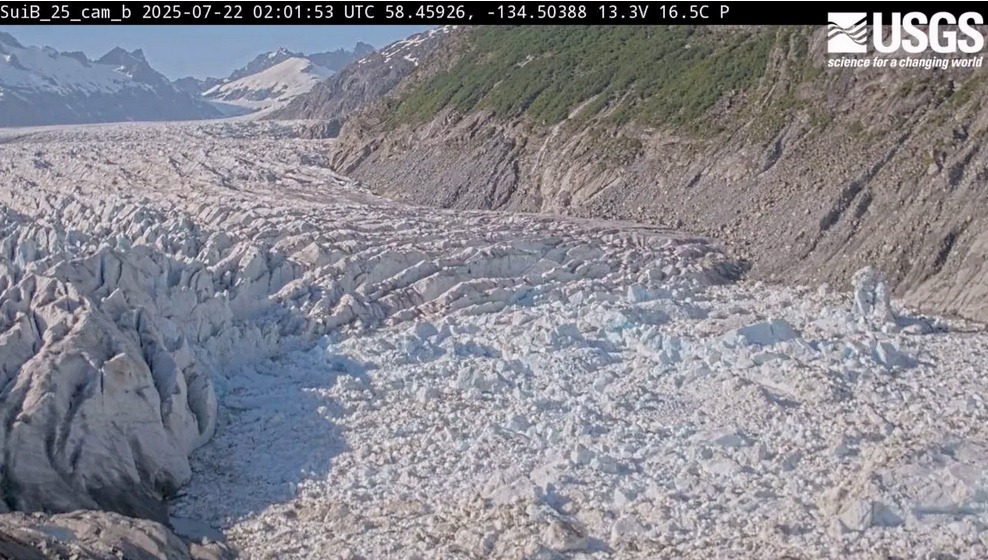
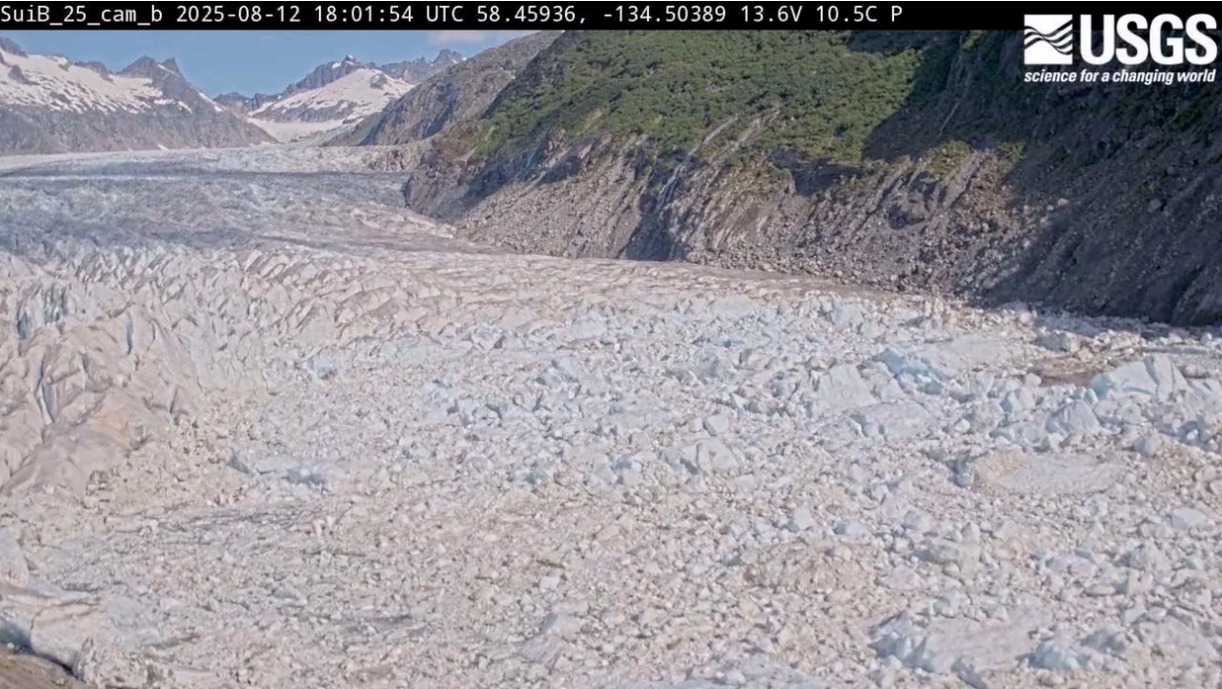
The National Weather Service (NWS) Juneau office issued a flood warning for areas along the Mendenhall River near Auke Bay. The released water from this glacial outburst is flowing downstream, putting riverside homes and properties at immediate risk. As of Tuesday afternoon local time, river levels were measured at 9.85 feet, with major flooding classified at 14 feet. Officials expect the river to crest Wednesday afternoon at near-record levels of 16.3 to 16.8 feet, setting a new historic high. NWS meteorologist Nicole Ferrin stated, “This will be a new record, based on all of the information that we have.” The City and Borough of Juneau issued a public advisory confirming that the glacial outburst originated from Suicide Basin. Flooding is expected to continue along Mendenhall Lake and River from late Tuesday through Wednesday. Residents in areas at risk are strongly encouraged to evacuate immediately. A Red Cross shelter is open at Floyd Dryden Gymnasium (3800 Mendenhall Loop Road). Important notices for pet owners: The Red Cross shelter cannot accommodate pets. Evacuated animals should be taken to Juneau Animal Rescue at (907) 789-6997. Safety warning: Do not approach the river. Floodwaters are extremely dangerous, and entering the area endangers both residents and first responders. Stay away from the river to allow safe evacuations and emergency response efforts.
The Mendenhall River crested today at a record-setting 16.65 feet deep as of 7:15 a.m. Alaska time (12:15 Eastern).
Ignite a Domino Effect: Albedo, Brown Carbon, AMOC, Permafrost, Amazon Rainforest Dieback, Outbursts and Sea Level Rise Pulses, Hydroclimate Whiplash, and Arctic Sea Ice Brouse and Mukherjee (2025)
- Sudden Sea Level Pulses: How “Cork Release” Events Could Rapidly Reshape Coastlines Brouse and Mukherjee (2025)
- What Happens If the AMOC Stops? Brouse (2025)
- Lightning, Extreme Weather, and the Climate Change Connection Brouse (2025)